
Somerset agree deal with Migael Pretorius for 2027: Fourth campaign to cover all three formats
सोमरसेट काउंटी क्रिकेट क्लब ने दक्षिण अफ़्रीकी सीम-गेंदबाज़ी ऑलराउंडर मिगेल प्रिटोरियस के साथ 2027 सीज़न के लिए करार किया है। यह उनका टॉंटन में चौथा अभियान होगा और वे काउंटी चैम्पियनशिप, वाइटैलिटी ब्लास्ट तथा वन-डे कप — तीनों प्रारूपों में उपलब्ध रहेंगे। 31 वर्षीय खिलाड़ी ने सौमरसेट के लिए 40 अवसरों पर 827 रन बनाए और 106 विकेट लिए हैं; सर्वोच्च स्कोर 95* (नॉटिंघमशायर के ख़िलाफ़, 2024) और सर्वश्रेष्ठ गेंदबाज़ी 5-64 है। वे 2025 की वाइटैलिटी ब्लास्ट जीतने वाली टीम का हिस्सा थे। आँकड़े प्रारूप-मिश्रित हैं, इसलिए औसत या इकॉनमी नहीं निकाली जा सकती। करार की वित्तीय शर्तें और यह जानकारी सार्वजनिक नहीं है कि वे विदेशी (ओवरसीज़) खिलाड़ी के रूप में दर्ज होंगे या घरेलू-योग्य — यह इस करार का सबसे निर्णायक अनुत्तरित प्रश्न है।
Somerset County Cricket Club have agreed a deal with South African seam-bowling all-rounder Migael Pretorius for the 2027 season. The announcement is unusual in that it is not for the imminent campaign but is a forward-dated commitment two seasons ahead, and it explicitly states that the player will be available across all three formats of English domestic cricket — first-class County Championship cricket, T20 Vitality Blast cricket and List A One-Day Cup cricket. Bringing all three formats under a single agreement is a strong signal in the county game. It will be Pretorius's fourth campaign at Taunton.
The deal at a glance
According to the available information, Pretorius is 31 years old and has made 40 appearances for Somerset, scoring 827 runs and taking 106 wickets. His highest score is 95 not out, made against Nottinghamshire in a County Championship match in 2026, and his best bowling figures are 5-64. He was part of Somerset's 2026 Vitality Blast-winning squad. A club official said the player "positively impacts matches with the ball and the bat" and that the deal will "add depth and quality to our squads". Notably, no financial terms, salary or contract length beyond a single season have been disclosed.
Who is Pretorius: a four-season journey
This is not a story about a player's performance but about a club's planning and continuity. Agreeing a new deal for 2027, after three seasons already spent at Somerset, suggests the club sees him not as a stop-gap but as a permanent part of its squad plan. County cricket has a tradition of renewing overseas players season by season, which protects the club from long-term risk while giving the player recurring security. But when one agreement covers all three formats, it becomes clear the club is not signing him for the Blast alone; it wants his services across the entire English summer programme. The English domestic season runs from April to September. A fourth consecutive season at one club is not rare for an overseas player, but it is not routine either. It shows the club's assessment of his utility at Taunton is stable and that he has established a place.
Reading the numbers: bowler first, batter second
Taking 106 wickets in 40 appearances for Somerset points to a frontline seam bowler, while scoring 827 runs in the same period looks like a useful lower-order contribution rather than genuine top-six run production. Whatever the all-rounder label, in the language of the data his first identity is as a bowler and his second as a batter. Dividing 827 runs across 40 appearances gives roughly 20.7 runs per appearance, modest for a player described as one who changes matches with the bat. On the other hand, 106 wickets across 40 appearances averages about 2.65 wickets per appearance, a strong return for a frontline bowler.
A serious methodological caveat is essential here. These figures pool first-class, List A and T20 cricket. A wicket taken in a four-over T20 spell and a wicket taken in a 20-over Championship innings are not the same unit. Deriving an average, strike rate or economy from these aggregate numbers would therefore be methodologically unsound. They are only a volume indicator. Moreover, it is not clear whether "40 appearances" means 40 matches or 40 innings — an ambiguity that must be resolved before any deeper conclusion can be drawn.
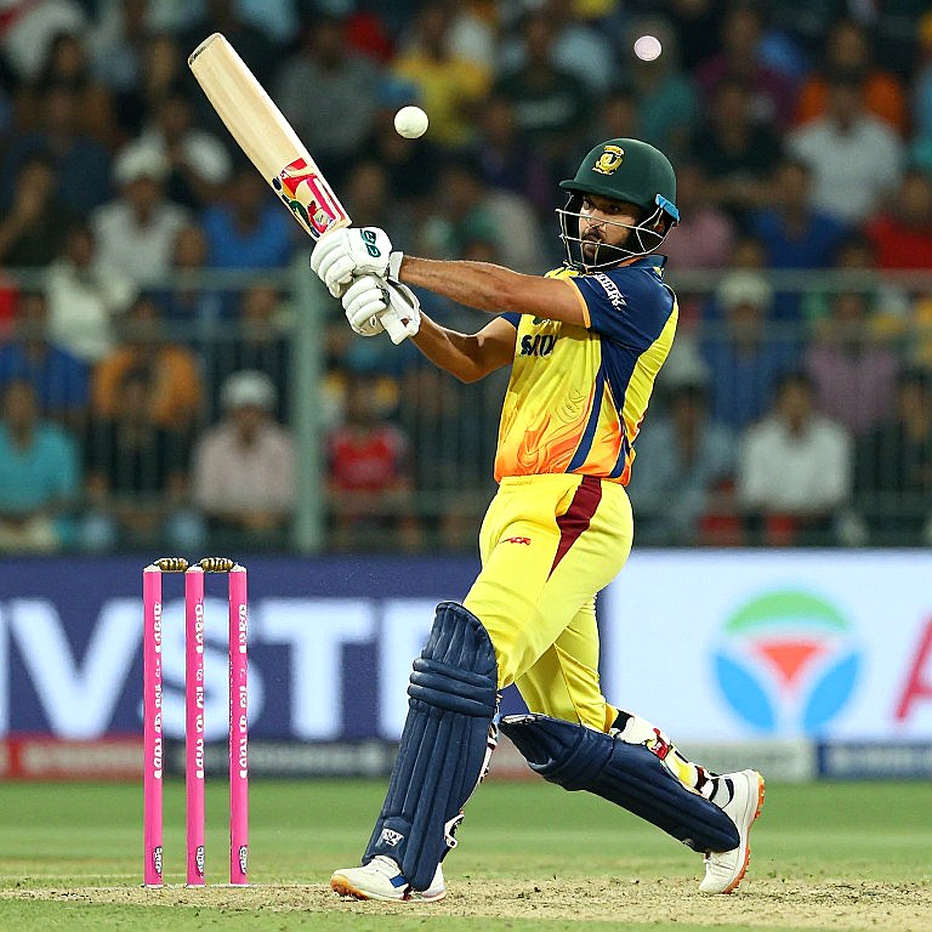
*95 and 5-64: the difference between brilliance and consistency**
The two most eye-catching figures in the press release are 95 not out and 5-64. Both are one-off innings of excellence, not proof of consistency. The source does not say how often he reached 50+ or took four or more wickets, so the distribution of performance is unknown. One interesting detail is that the 95 not out came at Trent Bridge, a traditionally seam-friendly away ground, which may hint at technical competence rather than pure hitting — though that is only a weak inference from a single innings.
Crucially, both headline performances come from longer-format contexts. The 95* is explicitly a County Championship innings and the 5-64 is also a long-innings figure. This means the "T20 all-rounder" framing that the 2026 Blast title naturally creates is not directly evidenced by the numbers. The Blast title is a collective team outcome, and Pretorius's individual contribution — matches played, wickets taken, economy rate — is nowhere recorded.
The real value is the scarcity of the all-rounder
If the batting numbers are modest, why is Somerset making such a commitment? The answer lies not in raw runs but in the economics of team balance. A player who can bat at seven or eight and simultaneously serve as a sixth bowling option is extremely valuable in county cricket. It gives the captain the freedom to field an extra specialist bowler or strengthen the batting. That scarcity argument, not the volume of runs, lies behind the deal. The club official's "with the ball and the bat" phrasing looks asymmetric against the numbers, but it is coherent in the context of squad structure.
Three formats, three different roles
Availability across all three formats implies three entirely different strategic roles. In first-class cricket he will be seen as a seam-bowling all-rounder bowling 15 to 20 overs an innings. In T20 he becomes a four-over middle-order or death bowler. In the One-Day Cup he can play the role of a middle-overs controller. This is precisely why pooling the three sets of numbers is dangerous, because the criteria for success differ. The source contains no match-level or phase-level data (powerplay, middle overs, death overs, new ball). Any claim about his death-overs execution, new-ball potency or batting-position fit would therefore be speculation, not fact.
Taunton: a batters' ground, a test for bowlers
Somerset's home ground, Taunton, is historically counted among England's higher-scoring first-class venues with smaller boundaries. On such a ground batting returns are artificially inflated and seam bowlers are punished on flat mid-summer pitches. This information is not explicitly given in the article but is general venue knowledge and should be treated as contextual with medium confidence. The direct implication is that Pretorius's home numbers may partially mask his true ability, and his away record — absent from this source — could tell a different story. Similarly, the English season runs from April to September; early-season green, seam-friendly pitches and mid-summer dry surfaces are two different challenges. No weather, dew or DLS information is available.
The 2026 T20 Blast title and what it means
The only concrete on-field outcome in this entire episode is collective: Somerset winning the 2026 Vitality Blast, of which Pretorius was a part. This provides a results-based justification for the renewal, even though the individual contribution is undocumented. But caution is needed: a team winning a title is not proof of any one player's individual effectiveness. That is why presenting this title as proof of Pretorius's "T20 expertise" would be misleading. It is a team success, and how decisive his role in it was cannot be established from this report.
The age curve: what to expect at 32-33
Pretorius is currently 31, which means he will be around 32-33 during the 2027 season. County overseas signings are typically made in the 27-32 age range, so this deal falls into the mid-to-late career category. This is a significant inflection point for a seam-bowling all-rounder. Under the normal age curve, fast-bowling durability and pace gradually decline, while batting levels often hold or even improve. This means that by 2027 his value may be relatively stable with the bat and somewhat reduced with the ball. The deal is also a wager, and the single-season structure limits this risk because the club does not commit to a long-term liability.
Somerset's squad structure and the plural 'squads'
The plural use of "squads" in the club statement is significant. It confirms that Somerset runs separate teams for different formats, consistent with the modern county model, rather than one fixed eleven. A player available in all three formats fits directly into this structure. The deal signals continuity rather than rebuild — retaining a 31-year-old for a fourth campaign indicates the club believes its competitive window is open now and that the squad structure is settled. However, the source contains no real data on Somerset's squad depth, bench strength, age structure or ranking. There is no County Championship table, no Blast group points and no win-loss record, so no quantitative assessment of the club's level is possible. Any claim about "tier" is contextual, not evidential. The deal also matters because it locks a slot for 2027 two seasons in advance — a signal that the market for multi-format overseas all-rounders is competitive or that the club is planning its overseas quota long-term.
The economics of the overseas slot
This is a story of talent retention in a low-inflation labour market, not of an auction or financial windfall. There is no draft or auction in county cricket; recruitment is by direct contract negotiation. IPL concepts such as Right to Match, mega auction or purse do not apply here. The transaction value is also undisclosed, so no over- or under-valuation judgement is possible. The premium here is not a talent premium but a "scarcity of availability" premium — what is purchased is three-format presence for a whole English summer, not elite per-format output. Covering all three competitions with one registration avoids the administrative and financial cost of mid-season re-recruitment, which is cheaper for a county than three short-term deals. It is also worth noting that a full English summer commitment does not directly clash with other T20 leagues such as MLC in the USA or the CPL in the Caribbean, because the January-February leagues (such as SA20) fall outside the English season. In principle a South African player can combine a January franchise league with a full English summer. But this depends on South Africa's selection plans or central contract, information not present in this source.
Registration, visa and eligibility: the biggest unanswered question
At the level of governance and regulation, there is one strategically decisive unknown in this whole episode — Pretorius's registration status. Will he be registered in England as an overseas player or as a domestically qualified player? This is a decisive question because it determines whether Somerset have spent one of their limited overseas slots for a whole summer or effectively gained a "free" three-format all-rounder. The source does not clearly answer this. Several administrative aspects are involved: overseas player registration rules, post-Brexit visa and Governing Body Endorsement eligibility (the old Kolpak route is now closed), and the requirement for a No Objection Certificate from the South African cricket board. Whether he has played for South Africa in any format, whether he holds a central contract, and whether he has dual nationality or British ancestry are all unknown and cannot be reliably verified from this source. This is not a violation but an information gap that could fundamentally change the practical value of the deal. Normally, an announcement two seasons ahead on a club website comes only after internal sign-off, so it is possible the eligibility question has already been quietly resolved — but that is an inference, not evidence. Note that there is no corruption, betting or political dimension in this routine contract story, and no such allegation should be made.
The financial backdrop of county cricket
In the broader economic picture, the structural financial fragility of county cricket is relevant. Counties depend heavily on ECB distributions and the surplus generated by The Hundred and international hosting, and counties that are not Hundred host venues (Somerset is one) are most exposed to distribution-policy risk. This is background knowledge and is not in the source. Thus the broad economic significance of this deal is near zero — no fee, no salary, no broadcast angle. Its industry value is moderate at the micro level of "how counties now build squads". It is essential to separate sporting from commercial value here: a county contract for a 31-year-old South African all-rounder carries real sporting utility and negligible commercial/traffic value — the exact opposite of the auction dynamic usually analysed.
Risk assessment
The biggest sporting risk is the decline of a seam-bowling all-rounder at 32-33 across a full three-format season. Bowling first-class overs and T20 spells in the same season raises the risk of soft-tissue or stress injury. A second risk is the mis-assumption of format transfer: 95* and 5-64 come from long-format cricket, so assuming equivalent T20 impact is unsupported. Third, squad-plan concentration — one overseas registration covers all three formats, so an injury leaves a hole that is hard to fill mid-season. Fourth, changes to ECB overseas registration or visa rules before 2027, or NOC/CSA release complications. Fifth, county fixture congestion and English weather disruptions — rain-affected Championship and Blast matches reduce the per-match-played value of a full-season deal. Financial risk is low because no sum is exposed. Public-opinion risk is negligible — no scandal, no rivalry sensitivity, no star-driven scrutiny.
Scenario projections
Worst case: a change in ECB overseas rules or visa criteria before 2027 invalidates or restricts the registration, forcing Somerset to re-recruit and exposing the squad plan. Likelihood low, impact moderate. Base case: the registration proceeds as a standard overseas signing available across all formats and the deal is completed as planned. Likelihood high, impact low. Best case: the arrangement is structured so that Pretorius counts as a domestically qualified player or does not consume a full overseas slot, materially increasing Somerset's squad flexibility. Likelihood unknown, impact high if true.
Conclusion and the road ahead
Overall this is a routine, low-value, low-salience domestic contract with no integrity, political or financial red flag. Its overall risk level is low. Its real significance lies in two things. First, it shows that county clubs are moving towards signing overseas players not for a single format but for the whole English summer, enabling more efficient use of the overseas slot. Second, it makes clear that sports journalism should not read press-release numbers without format splits — aggregate figures can mislead. The deal will prove meaningful if Pretorius's availability remains central to the club's season planning — that availability is the commodity being bought. And by 2027 it will also raise the question of whether his bowling impact can stay balanced with his batting load, or whether the hard workload system of county cricket pushes him towards a different, more limited role.