
From 14 to 13: Pakistan's Withdrawal and the Unfinished Ledger of the Commonwealth Kabaddi Championship
**मुख्य उत्तर**: पाकिस्तान ने कॉमनवेल्थ कबड्डी चैंपियनशिप 2026 से देर से नाम वापस लिया, जिससे पुरुष फ़ील्ड 14 से 13 देशों की हो गई। वापसी का कारण किसी आधिकारिक स्रोत ने नहीं बताया गया। यह आयोजन 23 से 31 अक्टूबर 2026 तक अहमदाबाद के वीर सावरकर स्पोर्ट्स कॉम्प्लेक्स में निर्धारित है। **मुख्य तथ्य**: - आयोजन की तारीखें 23 से 31 अक्टूबर 2026 और स्थान अहमदाबाद का वीर सावरकर स्पोर्ट्स कॉम्प्लेक्स है। - मूल सूची में 14 देश थे; पाकिस्तान की वापसी के बाद 13 रह गए। - ईरान और चीनी ताइपे इस चैंपियनशिप में शामिल नहीं हैं। - एशियाई खेल 2026 में भारत ने पुरुष और महिला, दोनों वर्गों में स्वर्ण जीता। - पाकिस्तान एशियाई खेल 2026 में कबड्डी का कोई पदक नहीं जीत सका। **स्रोत**: स्टेज-1 समाचार सारांश; प्रकाशन तिथि सत्यापित नहीं, सभी 17 सूचना बिंदु बिना नामित स्रोत के दर्ज हैं। पाकिस्तान की "पहली बार पदक-रहित" स्थिति ओलंपिक काउंसिल ऑफ़ एशिया के रिकॉर्ड से सत्यापन योग्य है। **संबंधित प्रश्न-उत्तर**: प्रश्न: पाकिस्तान ने कॉमनवेल्थ कबड्डी चैंपियनशिप 2026 से क्यों नाम वापस लिया? उत्तर: कारण आधिकारिक रूप से घोषित नहीं है; देर से आई राष्ट्रीय टीम वापसियाँ कबड्डी में अक्सर प्रशासनिक होती हैं, पर यह केवल परिकल्पना है। प्रश्न: इस आयोजन से कौन-सी टीमें अनुपस्थित हैं? उत्तर: ईरान, चीनी ताइपे और पाकिस्तान — तीनों इस बार फ़ील्ड का हिस्सा नहीं हैं। प्रश्न: कॉमनवेल्थ कबड्डी चैंपियनशिप किस प्रारूप में खेली जाती है? उत्तर: उपलब्ध विवरण स्टैंडर्ड स्टाइल का संकेत देते हैं, जो एशियाई खेलों और पीकेएल का 7-खिलाड़ी आयताकार प्रारूप है, पर आयोजक निकाय की पुष्टि नहीं हुई है।
The draw sheet for the Veer Savarkar Sports Complex in Ahmedabad carried fourteen names. A few days later the same sheet carried thirteen. One line had been erased — Pakistan. In any tournament's paperwork this is the plainest edit there is: one fewer name, everything else identical. My ledger had, until now, been a ledger of ankles — left corner, thirty-fourth minute, second half, after the optional hydration break. This entry is different. A whole squad has been erased, and nobody wrote down why.
The ledger began in 2026 at the NSCI Dome in Worli with one swollen ankle; by the end of that season it had become a calendar. By the Mumbai leg the left corner had absorbed 118 tackle exposures, nine ankles had rolled, and eight of those had rolled in the second half. That ledger gave me a habit: read an injury as a timetable, not an accident. Today a country has been removed from the Ahmedabad list, and I am asking the same question of it — who paid for this erased line, and which column does the cost go into?
One thing must be said plainly first, because the report in front of me says very little. All seventeen of its information points carry no named source. The facts this piece rests on — the dates, the venue, the number of nations, the Asian Games outcome — sit in the category of "as reported." And the question at the centre of the whole affair is raised in that report and then abandoned: why did Pakistan withdraw? Nobody answered. I will not invent the answer. I will show the arithmetic the available facts support, and I will mark which window is shut.
Context: what this tournament is, and why it matters
The Commonwealth Kabaddi Championship 2026 — inaugural edition, 23 to 31 October 2026, at the Veer Savarkar Sports Complex in Ahmedabad. The report calls it the "second major kabaddi event" of the calendar year, which means the first was the Asian Games 2026. That leaves international kabaddi with exactly two windows in a year, and no ranking or qualifying pathway linking them. This goes into my two-column notebook: what was said on the left, what the calendar shows on the right.
The original field had fourteen nations. After Pakistan's late withdrawal it has thirteen. Iran and Chinese Taipei were already absent. So this event is missing the world's second-strongest team and the one opponent with the oldest emotional and broadcast pull in the sport.
The Asian Games 2026 result, as reported, arrives in two sentences: India won gold in both the men's and women's events; Pakistan finished without a kabaddi medal. The report adds that Pakistan's run of at least a bronze was broken for the first time. I am holding that second claim carefully. Pakistan has stood on the Asian Games kabaddi podium at bronze and silver level in earlier cycles, so a "first ever" line needs checking against Olympic Council of Asia records. For now it is recorded, not verified.
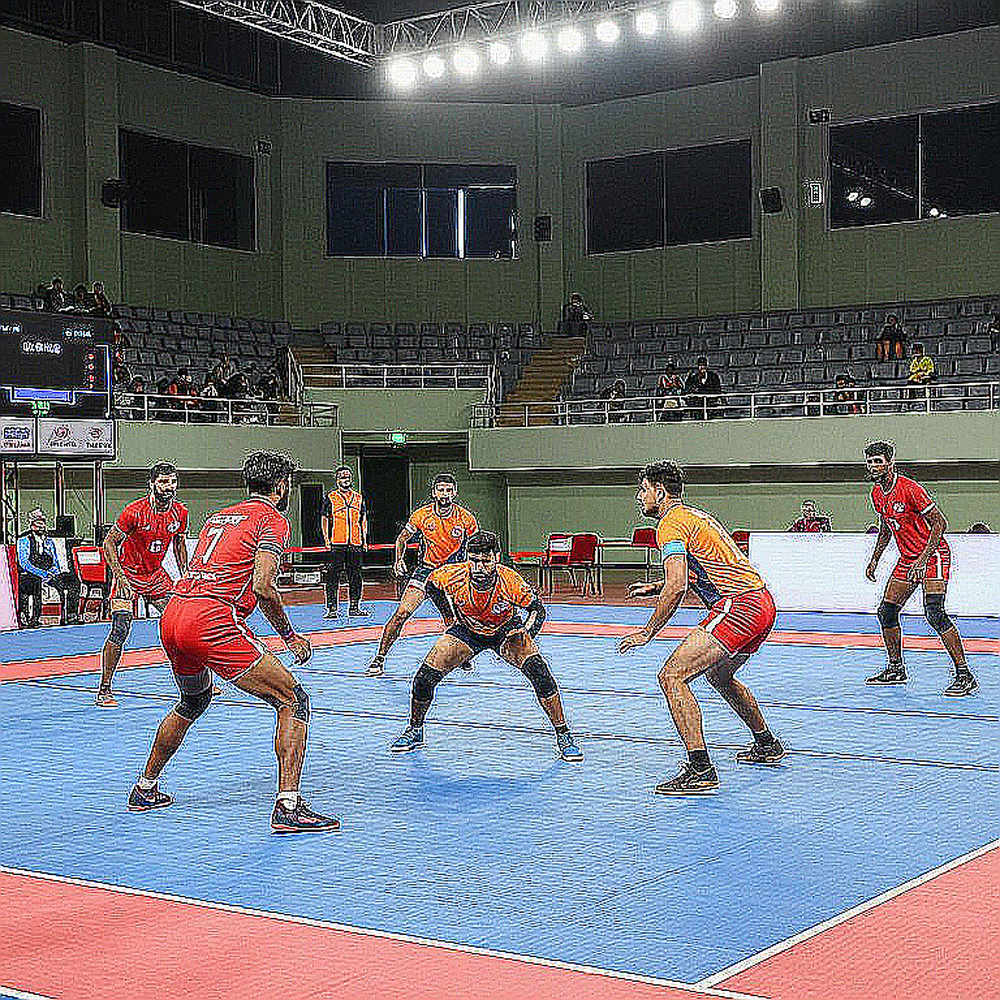
A basic rule primer is necessary here, because it is the hinge of the whole analysis. Kabaddi is played in two codes. Standard Style — rectangular 13m by 10m court, seven a side, the format of the Asian Games and the PKL. Circle Style — circular field, commonly eight a side, simplified scoring, dominant in the villages of Punjab on both sides of the India–Pakistan border. Everything a regular viewer recognises as kabaddi belongs to Standard Style: the thirty-second raid, the continuous "kabaddi-kabaddi" chant, the raid dying the moment the breath breaks. Add the do-or-die raid — after two empty raids, the third must score or the raider himself is out. The bonus line — one point for crossing deep into the opponent's half while six or more defenders are on court. The super tackle — two points for tackling with three or fewer defenders. And the all out — two points plus full revival, the rule that can erase a six-point lead in ninety seconds.
Core: two codes, one gap
If this championship is Standard Style — and the Ahmedabad venue paired with the Asian Games framing says it is — then filing Pakistan's absence under politics is the easiest route and possibly the wrong one. In my notebook the competitive question comes first, the political one after.
A raider raised in Circle Style grows up evading one opponent at a time. Retreat from a raid carries no penalty there, so risk is priced differently. Standard Style removes that allowance. The do-or-die rule directly punishes the raider trained to stall. Where the third raid must score, the art of escaping stops being a strategy and becomes a weakness. That is a structural point, not a comment on anyone's afternoon. I label it as such: a domain-level generalisation, not a claim about the 2026 Pakistani squad, whose list was never published.
On the other side sits the machinery Standard Style requires and Circle Style does not supply — corner and cover. Modern kabaddi is decided in two places: the left corner, where a raider is stopped by an ankle hold or a thigh hold, and cover, where the speed of the second man decides everything. That work is not built on enthusiasm; it is built on repetition. The ankle hold is a skill that requires a body to fall at the right height, at the right angle, at the right moment, and it does not form until someone has been put in that position hundreds of times. Pakistan's Standard Style defence has historically leaned on physical, upper-body tackling rather than the low ankle-hold discipline the modern game demands. Again a generalisation, not a claim.
Now the ledger I keep most closely — the exposure ledger. A team reaching the semi-finals of a thirteen-nation event plays six or seven matches of forty to fifty minutes, roughly two hundred and fifty to three hundred minutes of Standard Style match load. Add the training camp weeks, where the real conversion happens — the work that turns a Circle Style player into someone who can stand at a Standard Style corner. Pakistan did not merely skip a tournament; it removed roughly three hundred minutes of a load its domestic circuit cannot replace.

This is where 2026 returns to me, and I will set it down without decoration. From a Mumbai flat I ran video movement screens for thirty-four contracted players over eleven weeks, calling in from villages across Haryana, Punjab and Andhra — sand pits, concrete rooftops, one borrowed school ground. I found what I privately called silent load: men who had rebuilt their own training with no load ceiling, carrying groin and lower-back problems that appeared on no record. I flagged six to their franchises. All six were cleared fit. Three broke down within a month of the league's return. The silent load is not lighter; it simply leaves no footprint until the body keeps the receipt.
By the same logic I file Pakistan's absence in a column nobody usually opens. A team that skips an international window loses more than experience; it loses tissue loading and tactical loading at the same time. When it returns at the next window, it returns without the match tempo that the fixture will demand of it. That is a hypothesis, not a scan. I call it a hypothesis because I have no team sheet, no training-room log, no medical report. Within the bounds of a hypothesis, though, it is the cheapest explanation available and the least listened to.
Here I have to be most careful. The entire report contains no performance statistic. No raid points, no successful raid percentage, no tackle count, no squad size, no substitution rules, no confirmation of whether a separate women's draw exists. The drop from fourteen to thirteen is described as a men's reduction, which implies a women's field whose composition nobody examined. Without numbers I cannot say whether Pakistan's medal-less campaign was a raiding failure or a defensive collapse. A man who refuses to declare a player finished off one broadcast replay will not diagnose a system off a binary outcome. That is the rule of the two-column notebook: what was said on the left, what the tape shows on the right — and when the right column is empty, leave it empty.
So what remains? Structure. And the clearest line of structure is this: the event's ceiling is written into its own name. Kabaddi's international hierarchy is simple — India, then Iran, then everyone else. Iran is not a Commonwealth nation. The one team capable of beating India is therefore excluded by construction. That is a design flaw, not a scheduling accident. It is also why the number thirteen misleads: numerically large, competitively tiny. With Iran, Chinese Taipei and Pakistan all out, the effective field is India plus a group of nations for whom a semi-final is the realistic ceiling.
Which brings back the correction I keep in the file. In Jakarta, India lost the semi-final 18-27 to Iran and came home with bronze — the first missed gold since 2026. In that review room I charted Iran's wrestling-derived ankle holds and chain tackles against Indian raiders who had spent the year training for mat speed. The lesson was uncomfortable: a side that plays only where nobody tests it arrives at an Iran fixture having lost its sharpness. India's real risk in this championship is not defeat. It is that nobody will test it at all.
There is a calendar problem too, and for me it is the most concrete issue on the table. The PKL's traditional October-to-December broadcast window collides directly with these 23-31 October dates. India's question is not simply first-choice or rested squad; it is which column the available players' load goes into. I keep this as a hypothesis because no Indian squad announcement has been confirmed. But a man who has kept ankle books for nine years knows what a second consecutive competition in October means, and knows that in such collisions the tournament with less television money always loses.
The women's gap deserves its own line, because it is the least visible part of this argument. Chinese Taipei's absence weighs more heavily in the women's draw than the men's — its women's programme has been a genuine Asian Games medallist. Its absence alongside Iran's suggests Asian federations are treating this event as a low-priority, non-ranking fixture. That is an old and inconvenient truth about a sport with four Asian Games golds in the women's game, no franchise league and no guaranteed medical staff. I keep saying it because a schedule is a document, and should be read like one.
The commercial arithmetic is just as plain. Iran's absence lowers the standard; Pakistan's removes the one fixture with genuine emotional and broadcast pull — India against Pakistan. Against that, the venue-hostility explanation is weak. The 2026 Kabaddi World Cup was staged in Ahmedabad with Pakistani participation. I write that from memory, not from a verified document — but if it holds, something other than the venue has changed.
Contrarian: the withdrawal may have been rational
Here is the uncomfortable part. We are all reading this withdrawal as a statement. The ledger reads it as a cost.
A team that has just broken a long Asian Games medal run, whose domestic circuit is Circle Style, which has no PKL pathway and no overseas club route — what does it gain by entering a format it has not converted to? Three matches, three defeats, another public decline. Staying home is, on paper, the cheaper transaction. I am not saying that was the reason. I am saying we have no basis to rule it out, because nobody stated the reason.
And one possibility strikes me as more likely still. Late national-team withdrawals in kabaddi are frequently administrative — clearance, visas, the release of funding. Hypothesis, not claim. If it holds, though, the entire frame of this debate is wrong. We are reading a sporting-political story when there is a file sitting on a clerk's desk.
The largest point is that we cannot even measure the loss. A thirteen-nation field can be numerically large and competitively tiny — and until a squad list, a statistic or a sanctioning body is published, the loss is not measurable either. Inaugural, weakly sanctioned, field-depleted events are routinely over-labelled in South Asian media. Until the sanctioning authority is confirmed, I keep this event's prestige rating provisional.
International kabaddi's structural problem is event scarcity — the report itself concedes that international competition is limited — and this withdrawal makes it worse rather than better. With two windows in a year, one forfeited appearance costs a national programme a disproportionate share of its annual development value.
Takeaway
I have three dates: 23 October, 31 October, and the one nobody wrote down — the day Pakistan pulled its name. The third is the most important and the least recorded.
What to watch is clear. Confirmation of the sanctioning body — the IKF, a Commonwealth kabaddi body, or a national federation running it alone. Release of the draw and fixtures, and India's selection: first choice or rested. Whether a women's draw is ever named. And the largest question of all — whether Pakistan returns at the next Standard Style window, or whether this was a decision about a tournament or about a direction.
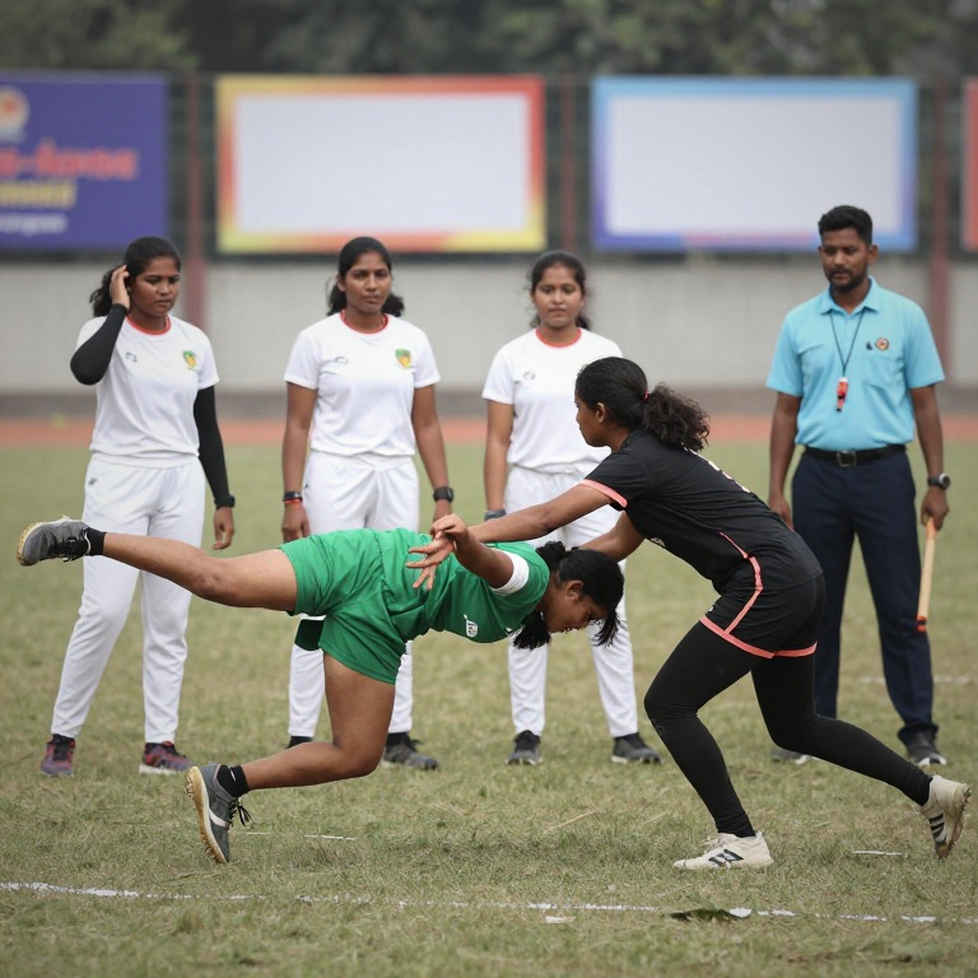
I found the injury before the scan did: a half-step shorter, a wince held too long. This time I do not have the half-step. I have one erased line, and a question: if a thirteen-nation field looks just as strong without that fourteenth name, did we ever measure how much weight the fourteenth was carrying?